Posts

Showing posts with the label economics

Economics, trade, and politics

Image
This analysis concentrates on economics, but the questions for CompGov students revolve around the effects of sanctions on Iranian government and politics. Will moderate or hard line forces be strengthened? Can Iran survive sanctions? New tough sanctions targeting Iran's oil sector, imposed by the United States, come into force on Monday [12 November]. The Iranian president, Hassan Rouhani, has responded robustly. "There is no doubt that the United States will not achieve success with this new plot against Iran as they are retreating step by step." Iran is heavily dependent on its exports of oil, and renewed sanctions, if effective, would hit the economy hard. Iran has the fourth largest reserves of oil. The EU has proposed supporting companies trading with Iran despite these new sanctions. But will these companies risk being hit by secondary sanctions which would limit their own ability to trade with the US? But other countries, including those of the European Union, ...
Inequality not related to GDP

Image
Oxfam (Oxfam?) identifies Nigeria as most unequal nation — again. Nigeria Again Ranked Highest On Inequality Index From " Daily Trust " For the second time, Nigeria has been ranked the country with the highest inequality among its citizens by OXFAM. OXFAM, a global civil society body that fights against injustice, and its partners indicate that Nigeria's social spending (on health, education and social protection) is shamefully low, which is reflected in very poor social outcomes for its citizens. "One in 10 children in Nigeria does not reach their fifth birthday, and more than 10 million children do not go to school. Sixty percent of these are girls," the report said. The index, released yesterday at the Annual International Monetary Fund and World Bank Meetings in Bali, Indonesia… showed that in the past year, Nigeria recorded increase in the number of labour rights violations. Its minimum wage has not increased since 2011 and social spending has stagnated. T...

As the price of dollars in Tehran goes up, the economy goes down.

Image
So, prices are going up very, very rapidly. What's the government have to with that? What politicians are likely to benefit? Which ones are likely to suffer? Iranian economists: The country is suffering highest inflation rates since WWII In an open letter, over 50 Iranian economists warned of a collapse in the Iranian economy, stating that the severe inflation of the rial has hit a high it had never reached in the past 75 years, since World War II. They also considered the continuation of what they called “wrong economic policies” that would lead to the suffering of Iranian families as the reason for this high rate of inflation in the country, according to the Iranian news agency ILNA. The experts also called on the heads of the parliament and judiciary to intervene... The experts pointed out that the current “incorrect policy” of managing the collapse in currency caused the currency to lose about 70 percent of its value since April under the threat of revived US sanctions, with he...

Cattle herders versus farmers in Nigeria

Image
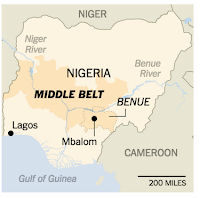
Can the people in Nigeria overcome culture, ethnicity, and economics to become Nigerians? Most news reports about the conflicts between farmers and herders in Nigeria's Middle Belt come from southern sources and seem to describe the herders as evil invaders. This report seems more balanced. Nigerian Herders Face Threat From Farmers Competing for Land Across parts of Nigeria, conflicts that mirror the 20th Century range wars in the American West have broken out between farmers and herdsmen vying for land, leading to bloody battles. In the first six months of this year, these clashes killed an estimated 1,300 people –- six times the number who died in the war with the Islamist extremist group Boko Haram in the same period, the International Crisis Group says. About 300,000 people have been forced from their homes because of violence between farmers and herders, conflicts that are often exacerbated by religion, ethnicity and even the erratic weather patterns that accompany climate ch...

Is economics political? Are politics economic?

Image
Watch for how the government and politicians react to this crisis. How would you react if the money in your pocket and in your bank account suddenly would buy only half of what it could have bought yesterday? Who would you blame? Iran’s Currency Crashes. Shortages and Fears Rise. Iran’s rial fell to a record low on Wednesday, part of a staggering drop in the currency’s value since the United States pulled out of the nuclear deal only four months ago… Iranians line up to exchange currencies Signs of the currency chaos can be seen everywhere in Tehran: Worried residents lined up outside beleaguered money changers, travel agents offered vacation prices only in hard currency, and diapers disappeared from store shelves… There was no immediate acknowledgement of the drop on state media. Iran’s economy has faced troubled times in the past, whether from the shah’s overspending on military arms in the 1970s or the Western sanctions that came after the 1979 Islamic Revolution and United Stat...

More on philosophical liberalism

Image
So I discovered that The Economist is doing a whole series on "Liberal Thinkers." The first one, which I missed in the throes of moving, was about John Stuart Mill. In future weeks the essays will be about John Maynard Keynes, "Schumpeter, Popper, and Hayek," "Berlin, Rawls, and Norzick," and "Rousseau, Marx, and Nietzsche." Look for them. Against the tyranny of the majority Above all, though, like all liberals Mill believed in the power of individual thought. His first big work, “A System of Logic”, argues that humanity’s greatest weakness is its tendency to delude itself as to the veracity of unexamined convictions. He renounced shibboleths, orthodoxies and received wisdom: anything that stopped people thinking for themselves. He wanted them to be exposed to as wide a range of opinions as possible, and for no idea or practice to remain unchallenged. That was the path to both true happiness and progress… As Richard Reeves’s biography makes ...

Unrest in Iranian cities

Image
Things are not going well at the grassroots in Iran. BTW, when there are protests in South Tehran, the less affluent area of the city, unrest has spread beyond the wealthy, educated people. Iran protests resume for 6th day amid violent clashes with security forces Protests renewed in Tehran and several Iranian cities on Sunday evening, marking the sixth consecutive day of protests against the regime’s policies while some violent clashes erupted between protestors and security forces in some cities. Scene in Tehran, August 5. According to videos published by activists, there were protests in the neighborhood of Ekbatan, northwest of Tehran, in other areas like Daneshjoo Park in the center of Tehran, and in the streets of Karagar and Amir Abad in South Tehran. Protestors in Enghelab Street, in the center of Tehran, were chanting “Death to the Dictator.” A video showed security forces attack protestors while some young men burnt trash bins to obstruct the security forces’ advance. Violen...

Unrest in Iran

Image
What has the government in Iran done to deal with protest and dissatisfaction there? Iran Is Changing, but Not in Ways Trump Thinks President Trump says his decision to leave the nuclear agreement is already having a huge impact on Iran. He is right, Iranians say, but for the wrong reasons… [A]nalysts say there has been little or no change in Iran’s regional posture. The real impact to date has been on internal politics, with a repression on the slightest hints of dissent, and the economy, after the reimposition of sanctions. “A good economic and political process was underway in Iran,” said Mirzababa Motaharinezhad, a spokesman for Mardomsalary, a moderate political group. “Unfortunately, after Trump pulled out from the deal openness ended here and a crackdown on activists resumed.”… [I]n the small alleyways of Tehran’s bazaars and the luxury car dealerships in the affluent northern parts of the city, Mr. Trump’s withdrawal from the nuclear agreement has definitely added to economi...

Cleavages and conflict

Image
This is a great article that identifies cleavages and causes of conflict. Where are the conflicts happening? What are the causes? What factors limiting the government? Nigeria’s Farmers and Herders Fight a Deadly Battle for Scarce Resources Clashes between armed herdsmen and farmers in Nigeria are escalating to increasingly violent episodes as a battle for scarce resources stirs long-held tensions over religion and ethnicity… On Friday and Saturday night dozens of suspected armed herders, who are Muslim and of the Fulani ethnicity, descended from surrounding hills into several villages, opening fire, burning homes and shooting to death some people, most of them Christian and of the Berom ethnicity, as they slept. The killings immediately triggered reprisals as young people from the villages set up road blocks and killed anyone suspected of being Muslim and Fulani. One police commissioner in the area said at least five people died at checkpoints. Conflict between herders and farmers ov...

Details, details

Image
Nigeria has a budget (appropriations bill) for the current year. Buhari signs 2018 budget President Muhammadu Buhari has signed the 2018 appropriation bill containing the year’s federal spending details as approved by the National Assembly… Buhari signs the budget The total budget is N9.1 trillion, up from the N8.6 trillion estimates he submitted to the Assembly on November 7, 2017. The two chambers of the National Assembly passed the budget on May 16, six months after it was presented by the president… Teaching Comparative blog entries are indexed. Use the search box to look for country names or concept labels attached to each entry. Just The Facts! 2nd edition is a concise guide to concepts, terminology, and examples that will appear on May's exam. Just The Facts! is available. Order HERE . Amazon's customers gave this book a 5-star rating.

Budget and economy under threat in Nigeria

Image
If the Nigerian government is funded primarily by oil production, what happens if production falls? Will higher oil prices rescue everyone again? Nigeria’s oil output drops by 150, 000 bpd under Shell’s force majeure NIGERIA’s daily oil output has dropped by 150,000 barrels per day (bpd) as a result of the shutdown of Nembe Creek Trunk Line. In its 2018 budget, the Federal Government had earlier projected to produce 2.3 million bpd at the reference price of $51 per barrel. But with this development the target would not likely be met. But the development has not yet impacted on the market as Vanguard’s survey of the oil markets around the world showed that the price of Nigeria’s Bonny Light was still a little below $80 per barrel… Investigation showed that despite increased government romance with stakeholders in the Niger Delta, the region has continued to record pockets of pipeline vandalism, meaning that oil operations may still under threats of disruptions. In its latest report re...

Coming of age in China

The dilemmas facing rural migrants in urban China In China’s cities, young people with rural ties are angry Over the past 40 years, hundreds of millions have [moved from village to city], providing the blood, sweat and tears of China’s economic miracle. The Communist Party has often congratulated itself that such a vast movement of people has happened without mass unrest. But those… who have left rural areas more recently challenge the party’s sense of security. They face a wider range of problems than earlier participants in the rural exodus. They are dissatisfied with their lot and have little to lose. They may prove less quiescent than their predecessors. When observers of China think of threats to the party, they often focus on the rapid growth of the country’s new middle class… But many Chinese analysts… fret about turmoil created by members of a social underclass: poor workers in the cities whose family ties are rural… A study published in 2009 in the Beijing-based Economic Res...

The "belt and road" opens

Image
China's "Belt and Road" project opens its first connection to Europe. First China-Belgium freight train from China's Tangshan arrived in Antwerp After travelling 16 days and covering a distance of 11,000 km, the first China-Belgium freight train from China's Tangshan port has arrived in the Belgian port of Antwerp. The train with 41 containers which left Tangshan on April 26, was officially welcomed on Saturday in Antwerp. The direct railway link between China and Belgium is part of the China-proposed Belt and Road Initiative… Luc Arnouts, Director International Networks, Antwerp Port Authority, said at the welcoming ceremony that "This direct train link puts our port on the BRI (the Belt and Road Initiative) map and will further strengthen our ties with China. We have long been working on this project, which represents an important milestone in our trade relations with China." In his speech, Guo Jianjun, economic counsellor of the Chinese Embassy in B...

Now, that's embarrassing

Image
The Chinese company that made shoes for Ivanka Trump's company exports jobs to Ethiopia. Chinese firm featured in government-backed propaganda film accused of labour rights abuses Huajian Group, a company that made shoes for Ivanka Trump and stands accused of serious labour violations plays an unexpected role in a blockbuster propaganda film about China’s renaissance under President Xi Jinping. Huajian factory in Ethiopia The state-backed documentary Amazing China portrays the Huajian Group as a beneficent force spreading Chinese influence and prosperity – in this case, by hiring thousands of Ethiopians at wages a fraction of what they would have to pay in China. But in Ethiopia, Huajian workers told Associated Press they work without safety equipment for pay so low they can barely make ends meet… With epic cinematography, Amazing China articulates a message of how China would like to be seen as it pursues President Xi Jinping’s vision of a globally resurgent nation, against a re...

Unrest in Iran

Image
It appears that economic protests are taking place in Iran. (See the original article for some important charts.) Labor Strikes and Worker Protests Erupt Across Iran: ‘This is Slavery’ Teachers went on strike in central Iran’s city of Yazd. Steelworkers and hospital staff walked off the job in the southwest city of Ahvaz. Railway employees protested near Tabriz. And a bus drivers union in Tehran battled the private companies that control many city routes. These were among the hundreds of recent outbreaks of labor unrest in Iran, an indication of deepening discord over the nation’s economic troubles. Workers are turning not only against their employers but also Iran’s government, piling pressure on leaders who promised but failed to deliver better times in the two years since economic sanctions were lifted in the nuclear deal… Prices of eggs, meat and bread are rising more than 10% a year, compounding consumer woes. Unemployment is about 12%, and the Iranian rial has fallen sharply ag...

Money and legitimacy

Image
If a government mismanages an economy, how is its legitimacy affected? Steep Slide in Currency Threatens Iran’s Economy All this week panicked Iranians have gathered in throngs outside banks and other financial businesses hoping to buy dollars, as the government seeks to head off a collapse in the rial, the national currency. But they have met with nothing but frustration, told there were no dollars or other currencies for them to buy at the official government rate… Forex rates in Iran Long on a downward path, the rial plunged this week, losing 35 percent of its value against the dollar and hitting what has been widely described as a record low. The government is seeking to impose an exchange rate of 42,000 to the dollar, but in Tehran’s black-market exchanges this week the going rate was 60,000… In an effort to squelch currency speculation, the government sent riot police into the bazaars on Wednesday, where they arrested several money changers… However, many of those changing m...

Bring 'em back

Image
China encourages students to study in the USA and Europe. The big problem is that many of those students don't come back to China. The State Council has said they want to encourage more young people to return. What incentives ae they offering? This report comes from Xinhua , the Chinese news agency. China will intensify efforts to encourage return of overseas talent China will roll out more incentives for overseas Chinese students to return for starting their own businesses and making innovation, a State Council executive meeting chaired by Premier Li Keqiang decided… Measures will be introduced to simplify the certification requirements and procedures at local levels and to make it easier for overseas Chinese students to obtain hukou , the government system of household registration for urban residency. Favorable policies concerning the schooling of returnees' children will be implemented without delay, according to a decision at the meeting… Between 1978 and 2017, 83.73 per...