Posts

Showing posts with the label history

Nigeria political history
Image
Is Ernest Osogbue's analysis, published in The Guardian (Abjua), believable? Why? Why not? Why did he neglect to mention how many of the elected presidents were military "dictators" before being elected? Military Hangover And The Nigerian Democracy This year marked the 19th anniversary of civilian rule, albeit democracy in Nigeria. Never in the history of the country has there been such a long uninterrupted rule by ‘bloody civilians’ without the all-knowing Nigerian military stepping in to stem the negative drift. First, it was in January 1966, when a group of Majors… ousted the civilian government… Then in July of the same year a counter coup, that ultimately led to the fratricidal Nigerian civil war which ended in 1970, with the then Head of State Yakubu Gowon declaring that there was no victor and no vanquished. On July 30th 1975, Gowon was overthrown by members of his own government… December 31st 1983 [another coup] swept away the Shehu Shagari administration and b...
More on philosophical liberalism

Image
So I discovered that The Economist is doing a whole series on "Liberal Thinkers." The first one, which I missed in the throes of moving, was about John Stuart Mill. In future weeks the essays will be about John Maynard Keynes, "Schumpeter, Popper, and Hayek," "Berlin, Rawls, and Norzick," and "Rousseau, Marx, and Nietzsche." Look for them. Against the tyranny of the majority Above all, though, like all liberals Mill believed in the power of individual thought. His first big work, “A System of Logic”, argues that humanity’s greatest weakness is its tendency to delude itself as to the veracity of unexamined convictions. He renounced shibboleths, orthodoxies and received wisdom: anything that stopped people thinking for themselves. He wanted them to be exposed to as wide a range of opinions as possible, and for no idea or practice to remain unchallenged. That was the path to both true happiness and progress… As Richard Reeves’s biography makes ...

What's a liberal?

Image
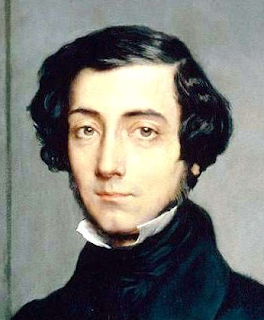
In the second of a series about liberals and liberal philosophy (the first was about John Stuart Mill), the editors of The Economist offer their understanding and prospects of de Tocqueville. It's good (even with some editing) for FRQs or debates. De Tocqueville and the French exception The gloomiest of the great liberals worried that democracy might not be compatible with liberty HE IS the most unusual member of the liberal pantheon. Liberalism has usually been at its most vigorous among the Anglo-American middle classes. By contrast, Alexis de Tocqueville was a proud member of the French aristocracy… Tocqueville believed that liberal optimism needs to be served with a side-order of pessimism. Far from being automatic, progress depends on wise government and sensible policy… Alexis de Tocqueville He broadened the liberal tradition by subjecting the bland pieties of the Anglo-American middle class to a certain aristocratic disdain; and he deepened it by pointing to the growing dan...

Cozy retreat for the Chinese elite

Image
Most of this is historical trivia, but it also offers clues about how the elite in China rule. Where China’s top leaders go in summer and in secret: a brief history of Beidaihe When state radio reported on Wednesday that Premier Li Keqiang met United Nations General Assembly President Maria Fernanda Espinosa in Beidaihe, it was the clearest confirmation that the annual summer gathering of China’s most influential politicians was taking place at the northern Chinese seaside resort. It was Chairman Mao Zedong, one of the key founders of the People’s Republic in 1949, who initiated senior party and government officials in Beijing to work at the famed seaside town of Beidaihe as early as 1953. Mao at Beidaihe Instead of the capital, all crucial meetings in the summer were held in Beidaihe from then on. In August 1958, party elites headed by Mao made two key decisions during an expanded meeting of the party’s Politburo held in the resort… The closed-door meetings were suspended for nearly ...

Cosplay as political education

Image
In China, the Long March was a crucial episode in the civil war of the 1930s. Beginning in Jiangxi Province, it was an epic retreat of the Communist army as the Kuomintang (Nationalists) tried to follow them. Mao Zedong became the leader of the Communist forces during the retreat. Now, educational tourism is a growing business in Jiangxi. China’s ‘red education’ history tours and the rise of communist cosplay If anyone can best tell the scale and intensity of China’s “red education” drive to promote loyalty to the ruling Communist Party, it’s businessman Yu Meng. The 36-year-old runs the largest Red Army uniform rental business in Jinggangshan, a city dubbed the “cradle of the communist revolution” deep in the mountains of Jiangxi. Last year alone, his company rented uniforms to 256,000 people taking part in red ideology study tours. Political tourists in rented uniforms Yu started the Xiangganbian Red Army uniform company 10 years ago. But it’s only in the last three years that the bu...

Potemkin village

Image
When I saw Paul Krugman's opinion piece in the New York Times, I was reminded that the metaphor he used was helpful in explaining government and politics in Russia. Here's the introduction to his editorial. Now imagine how this image (a Potemkin village) could help make sense out of elections in contemporary Russia, a constitution that can be modified by the supermajority in the Duma, or Putin as virtually president for life. Do a web search for Potemkin Village to see how common the idea is. Trump’s Potemkin Economy According to legend, Grigory Potemkin, one of Catherine the Great’s ministers (and her lover), created a false impression of prosperity when the empress toured Ukraine. He supposedly did this by setting up fake villages, or possibly just facades, along her route, then dismantling them after she passed, and setting them up again further down the road. A movie set as a Potemkin Village There probably isn’t much if any truth to the story — among other things, Catherin...

Nigeria's money comes home

Image
A remarkable effort might return a huge pile of money to Nigeria. 'Abacha loot' to be given to poor Nigerians Money looted by Nigeria's former military ruler Sani Abacha is to be distributed to poor families, the government says. The distribution is to start next month after more than $300m (£228m) was returned by the Swiss authorities. The money, stolen by Abacha in the 1990s, is due to be given to around 300,000 households, with each getting around $14 a month. Critics fear the handouts could be a way to influence next year's election. At this rate, the payments - to be made to residents in 19 of Nigeria's 36 states - should last for about six years. The money was originally deposited in Luxembourg, and is a fraction of the billions of dollars allegedly looted while Abacha was in power from 1993 to 1998. He ruled Nigeria with an iron fist until his sudden death on 8 June 1998 after an apparent heart attack. President Muhammadu Buhari made the recovery of stolen as...

Ancient history

Image
In political terms the events of May and June 1989 are more ancient than the Qing Dynasty. The massacre that took place in Tiananmen Square on June 4 has been hidden from or forgotten by most people, but the political elite remembers well. Should we? Portraits of persistence: the Hongkongers refusing to let memories of China’s 1989 Tiananmen crackdown die Ahead of Monday’s anniversary of the 1989 crackdown on democracy protesters, the Post spoke to two of the few Hongkongers who witnessed the chaotic clearance operation. The pair shared how they narrowly escaped death amid the gunfire and tanks that ran across the city on the night of June 3 and early morning of June 4. Tiananmen Square, 1989 Kenneth Lam, then a student leader at the Chinese University of Hong Kong, has since become a local human rights lawyer, fighting for the rights of grass-roots workers. He considers his work an extension of the spirit that drove the Tiananmen protest movement almost three decades ago. Taking a dif...

Echo of civil war

Image
Fifty years ago, Nigeria nearly dissolved in war. Some people still wish for dissolution. Biafra shutdown cripples Nigerian cities A stay-at-home protest by Biafran separatists in Nigeria has crippled cities and towns in the south-east. Streets are empty and markets, banks and schools are closed to mark the abortive attempt in 1967 to gain independence for the region. It led to a bitter three-year civil war in which more than one million people were killed. The authorities have warned the secessionists against street protests and security forces are on patrol. South-eastern Nigeria is mainly inhabited by the ethnic Igbo community, who often complain of marginalisation - accusing successive governments of failing to develop their areas… The BBC Igbo service says there has been a total shutdown in the Igbo heartland of Enugu and Anambra states… People have been sending in photos to BBC Igbo of deserted streets, including one of the iconic Niger River Bridge in Onitsha, known as the ga...

Official version of history

Image
Remember what George Orwell said about history in his book 1984: “Who controls the past controls the future. Who controls the present controls the past.” The Communist Party in China is intent on controlling the past. China criminalizes the slander of its ‘heroes and martyrs,’ as it seeks to control history China’s Communist Party has always understood the importance of policing its history. On Friday, it tightened the screws further with a new law banning the slander of “heroes and martyrs” — figures drawn from wartime propaganda said to have given their lives in defense of the Communist Party or the nation. Lei Feng Chinese schoolchildren are taught about the heroic deeds of figures who fought against the Japanese during World War II, or who gave their lives for the Communist Party in the civil war with the Nationalists. Memorials to some of the most famous dot the country. Now, it will be illegal to suggest that those tales might not be wholly factual… (See Fact-Checking a Chines...

Does the past still influence China's present?

Image
Here's one to test out in class. Are there examples of these influences to be seen today? Five ways China's past has shaped its present To understand today's headlines about China's approach to issues such as trade, foreign policy or internet censorship, turn to its past. The country is perhaps more aware of its own history than any other major society on earth. That remembering is certainly partial - events like Mao's Cultural Revolution are still very difficult to discuss within China itself. But it is striking how many echoes of the past can be found in its present. Trade : China remembers a time when it was forced to trade against its will. Today it regards Western efforts to open its markets as a reminder of that unhappy period. Trouble with the neighbours : China has always been concerned to keep states on its borders pacified. That's part of the reason it deals so warily with an unpredictable North Korea today. Information flow : Today China's intern...