Posts

Showing posts with the label concepts

Someone studied comparative government and politics.
Image
Journalists are renowned for using the terms government and regime as synonyms. At least one of the editors at The Economist studied comparative government and politics long enough to learn the difference. [Thanks to Paul Fitzpatrick in Texas for pointing this one out.] Mexico’s new president sets out to change his country’s course   But did voters want a new regime or just a new government? [W]hen Andrés Manuel López Obrador declared that he would be the first Mexican president since 1910 to use the [National Palace] as his workplace, he was making a statement that was both political and historical. Mr López Obrador (known as AMLO to Mexicans), who won a landslide victory in a presidential election on July 1st, promises a “fourth transformation”, after those of political independence, Juárez’s assertion of national sovereignty and the revolution in 1910-17. “This is a change of regime, not just of government,” says Lorenzo Meyer, a historian sympathetic to AMLO. Although he doe...
A great little 8-minute video explaining the concept of soft power.   China's 'soft power' in Kenya In Kenya, China is everywhere. And with Mandarin schools and massive infrastructure projects, China's trying to grow its "soft power" throughout Africa. But can China convince Africans to love it?

Is China a democracy?

Image
The author of this opinion piece is John Keane, Professor of Politics at the University of Sydney and author of ‘The Life and Death of Democracy’. Are his arguments reasonable? Should we join in creating a new category of democratic governance: phantom democracy? Phantom democracy: a puzzle at the heart of Chinese politics As China rapidly moves to the centre of the international order, the question that’s becoming increasingly pertinent is: what kind of a political system is this new global power? In the booming business of China watching, the standard answer is that it is an “authoritarian” regime, with qualifiers such as “soft authoritarianism”, “hard authoritarianism” and “authoritarian capitalism” commonplace. But by all accounts, China is reckoned the antithesis of a “liberal democracy” defined by open competition among freely formed political parties. Some Chinese observers celebrate the advantages of this “authoritarianism” and welcome the triumph of a “post-democracy” freed fr...

More on philosophical liberalism

Image
So I discovered that The Economist is doing a whole series on "Liberal Thinkers." The first one, which I missed in the throes of moving, was about John Stuart Mill. In future weeks the essays will be about John Maynard Keynes, "Schumpeter, Popper, and Hayek," "Berlin, Rawls, and Norzick," and "Rousseau, Marx, and Nietzsche." Look for them. Against the tyranny of the majority Above all, though, like all liberals Mill believed in the power of individual thought. His first big work, “A System of Logic”, argues that humanity’s greatest weakness is its tendency to delude itself as to the veracity of unexamined convictions. He renounced shibboleths, orthodoxies and received wisdom: anything that stopped people thinking for themselves. He wanted them to be exposed to as wide a range of opinions as possible, and for no idea or practice to remain unchallenged. That was the path to both true happiness and progress… As Richard Reeves’s biography makes ...

What's a liberal?

Image
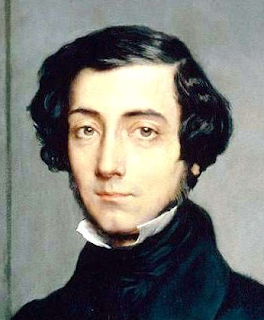
In the second of a series about liberals and liberal philosophy (the first was about John Stuart Mill), the editors of The Economist offer their understanding and prospects of de Tocqueville. It's good (even with some editing) for FRQs or debates. De Tocqueville and the French exception The gloomiest of the great liberals worried that democracy might not be compatible with liberty HE IS the most unusual member of the liberal pantheon. Liberalism has usually been at its most vigorous among the Anglo-American middle classes. By contrast, Alexis de Tocqueville was a proud member of the French aristocracy… Tocqueville believed that liberal optimism needs to be served with a side-order of pessimism. Far from being automatic, progress depends on wise government and sensible policy… Alexis de Tocqueville He broadened the liberal tradition by subjecting the bland pieties of the Anglo-American middle class to a certain aristocratic disdain; and he deepened it by pointing to the growing dan...

What brings democracy down?

Image
It was only 16 years ago that Francis Fukuyama wrote The End of History and the Last Man , a best selling book that celebrated the "victory" of democracy. Things look different in this part of the 21st century. What accounts for the changes? After decades of triumph, democracy is losing ground The world has grown far more democratic since the second world war. In 1941 there were only a dozen democracies; by 2000 only eight states had never held a serious election. But since the financial crisis of 2007-08, democracy has regressed. Most watchdogs concur. The latest survey by Freedom House, an American think-tank, is called “Democracy in Crisis”. In 2017, for the 12th consecutive year, countries that suffered democratic setbacks outnumbered those that registered gains… According to the Democracy Index from The Economist Intelligence Unit, a sister company of The Economist, 89 countries regressed in 2017; only 27 improved… What these indices measure is not simply democracy (ie...